

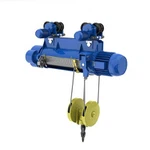
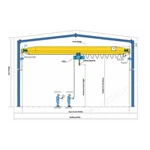
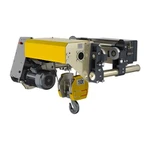


Crane Motor
The crane motor has the following characteristics:
- Adapting to harsh working environments: The lifting motor is designed specifically for the lifting and metallurgical industries, and can adapt to working environments such as frequent starting, braking, overload, reverse, over-speed, impact, and vibration. Its insulation level is divided into F level and H level, which are suitable for general and metallurgical places respectively, and can adapt to harsh working environments.
- Efficient and energy-saving: Electric motors are widely used in large cranes, and their high efficiency helps reduce energy consumption and save operating costs. In addition, the lifting motor and metallurgical variable frequency speed control motor combine the advantages of traditional lifting and metallurgical motors with the advantages of variable frequency motors, achieving soft start operation, reducing impact on equipment, and saving energy.
- Accurate and controllable: By flexibly adjusting the magnitude and direction of the current, the motor can achieve precise speed and torque control, ensuring the stability and accuracy of the crane's movements. With the help of advanced encoder and sensor technology, DC motors can provide extremely high position and speed control accuracy, meeting the needs of complex lifting tasks.
- Compact and lightweight structure: The European crane features lightweight design, long lifespan, small size, stable operation, and low noise.
- Good interchangeability: The installation dimensions of the lifting motor are the same as those of JZ and JZR motors, ensuring good interchangeability. Its power rating and installation dimensions comply with the International Electrotechnical Commission (IEC) standards, are the same as the German DIN42681 and Japanese JEM1202 standards, and are interchangeable.
In summary, the design of the crane motor fully considers its working environment and usage requirements, and has the characteristics of high efficiency, energy saving, precision, and durability.
The functions and roles of crane motors mainly include the following aspects:
- Main lifting motor: It is one of the core motors of the crane, mainly responsible for the lifting control of the boom, and can also be used for the control of winch lifting and hook lifting.
- Auxiliary lifting motor: usually installed on the auxiliary beam of the crane, used to control the lifting of the auxiliary arm and ensure that the crane operates under uniform load-bearing stress.
- Large vehicle traveling motor: installed on the large vehicle of the crane, controls the large vehicle to travel along the beam, and is used for large-scale material handling.
- Trolley walking motor: installed on the trolley, mainly used to control the walking of the trolley, and can move objects in the crane as needed.
- Crane motor: A squirrel cage rotor motor designed specifically for the lifting and metallurgical industries, combining the advantages of traditional lifting and metallurgical motors with the advantages of variable frequency motors. It can adapt to working environments such as frequent starting, braking, overload, reverse, over-speed, impact, and vibration. The lifting motor can not only operate stably under complex working conditions, but also meet the operational requirements under frequency converter control, achieve soft start and four quadrant operation, help reduce the impact on equipment, extend the service life of equipment, and save energy to a certain extent.
The above types of motors play an important role in the production, maintenance, and operation of cranes. The number and type of motors required for different models of cranes will also vary, and the coordination between these motors is particularly critical. Improper coordination and operation can easily lead to safety accidents
Hot Tags: crane motor, China crane motor manufacturers, suppliers, factory, Crane Hook, crane wiper system, crane rail joint bar, crane indicator light, crane safety cage, crane accessories
Previous
No InformationYou Might Also Like


Send Inquiry