


JIb Crane
Your Professional JIb Crane Supplier
Henan DF Crane Co., Ltd. is a leading crane manufacturer specializing in overhead cranes, gantry cranes, jib cranes, and electric hoists. With over 2,600 employees and an 850,000㎡ manufacturing base, we provide integrated solutions covering design, engineering, manufacturing, installation, and after-sales service. Our products are exported to more than 100 countries and are widely used in manufacturing, steel, mining, logistics, energy, and infrastructure industries. Backed by advanced production facilities and strict quality control, we deliver reliable lifting solutions for global customers.


why choose us
Global Project Experience & One-Stop Service
Operating from an 850,000㎡ production base with over 2,600 employees, we maintain high-volume manufacturing capabilities and efficient production management, ensuring stable quality, reliable lead times, and scalable supply for global industrial projects.
International Certifications & Compliance
Certified under CE requirements and ISO 9001 quality management standards, our cranes are designed and manufactured to meet international safety, quality, and performance requirements.
Rigorous Quality Control
Comprehensive inspection, testing, and traceability processes ensure every crane delivers safe and reliable performance.
Exported to 100+ Countries
Extensive international project experience enables us to provide customized lifting solutions that meet diverse industry requirements worldwide.

A jib crane is a type of overhead lifting machinery characterized by a horizontal rotating boom or cantilever that extends from a vertical support column or wall-mounted bracket. It is mainly used to efficiently handle materials within a limited area, with lifting capacities ranging from 250 pounds to 15 tons.
Product Introduction
|
Lifting Capacity: |
0.5t to 10t |
|
Arm Length: |
3m to 12m |
|
Lifting Height: |
3m to 10m |
|
Working Class: |
A3 |
|
Ambient Temperature: |
-25℃ to 40℃ |
|
Control mode: |
Handle operation, wireless remote control operation |
Benefits of Jib Cranes
Jib cranes are widely used across various industries due to their numerous distinct advantages
Flexible and Efficient Operation
Jib cranes can achieve 360° rotation (180° for some types), allowing the lifting mechanism to quickly move materials within a fan-shaped area without relying on overall track movement, reducing adjustment time. They are easy to operate, with precise control of lifting, rotation, and lowering via a console or remote control, making them highly efficient and suitable for assembly lines or frequent loading and unloading tasks.
Space-Saving Design
With a compact structure, column-mounted jib cranes occupy minimal floor space, wall-travel or wall-mounted models rely on walls or columns for support, and mobile units can be stored in corners when not in use. They are ideal for narrow workshops, small warehouses, or other space-constrained environments, optimizing limited space and improving work area utilization.
Easy Installation and Maintenance
Featuring few core components and no complex civil works, freestanding jib cranes use anchor bolts, while wall-travel or wall-mounted cranes rely on expansion bolts, resulting in short installation cycles and low costs. Routine maintenance is limited to lubricating and inspecting critical lifting and rotation components, reducing downtime and ensuring stable operation.
Reliable Safety Performance
Equipped with multiple safety devices such as overload limiters, brakes, and upper-limit stops, jib cranes effectively prevent overloading, overwinding, over-rotation, and over-travel, avoiding falling loads, equipment damage, and personal injury. Their structural design follows mechanical principles, using high-strength steel, and is rigorously calculated for strength and stability, ensuring safe operation within rated capacities.
Cost-Effective
Mid-sized jib cranes are priced lower than bridge, gantry, or tower cranes, fitting the budgets of small and medium enterprises. They also feature low energy consumption, minimal maintenance costs, and a service life exceeding 10 years under normal use, providing long-term economic benefits.
Industrial Applications of Jib Cranes
Jib cranes have many potential applications but are mostly used for repetitive lifting in small work areas of production environments or moving materials to nearby workstations in outdoor and indoor locations. They streamline production lines in these sectors:
Automotive industry: Handle and assemble heavy automotive parts while reducing risk and manual labor.
Construction: Lift heavy materials such as steel beams.
Manufacturing: Move raw materials and finished products and load and unload trucks.
Shipping: Load boats and transfer items between docks or trucks.
Warehousing: Stack, restack, and load and unload trucks.
Mining: Navigate narrow passages to load ore on carts, lower tools into shafts, and precisely place beams.
Below are some of the components and terms you’ll see mentioned throughout this article:
Reach/Boom – The horizontal beam that the trolley travels back and forth on.
Mast/Pillar – Tthe vertical beam used to support the boom on freestanding and mast systems
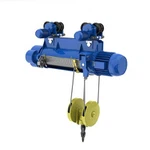
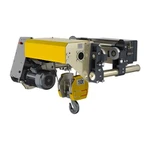
Movable Hoist – The hoist is used to lift, position, and lower a load.
Trolley – The motion of the trolley can be manual, motorized, or pneumatic. The trolley carries the hoist, wire rope or chain, and the hook along the entire length of the boom.
Rotation – On free standing and mast type jib cranes, you can achieve 360° of boom rotation. On wall and column-mounted jib cranes, you can achieve 180-200° of rotation.
Electrification/Pneumatic Power – Electric collector rings or pneumatic air lines can be added to the top or bottom of the mast to provide rotation assistance and allow for continuous 360° boom rotation.
Controls – On motorized or air-powered jib systems, you can use a push button controller to control the rotation of the boom, as well as the motion of the trolley and the lifting and lowering motion of the hoist. Multi-speed or variable speed controls are available for the hoist and trolley.
Hook Height – How high can you or do you want to go with your lifts? You’ll need to know the lowest overhead obstruction to know how tall your jib crane can be.
Rotation Stop – If the crane is located close to a wall or other obstruction, a rotation stop will limit the crane’s motion before it collides with a nearby object.
Environmental Considerations – The components of the jib system can be galvanized to resist corrosion for outdoor applications. Also, special control enclosures can be designed for explosion proof applications, and other environments where heat, dust and dirt, or moisture may be a factor.

Certifications


